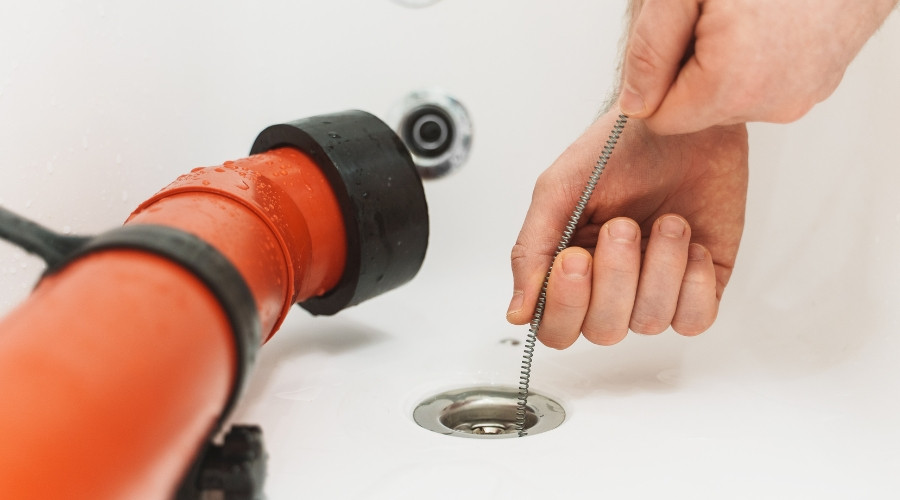
Plumber using drain snake to clear clogged drain line.

Hidden Signs a Drain or Sewer Line Is in Trouble

How to Identify a Clog and the Need for Drain Cleaning

Drain and sewer problems often begin quietly, with only small changes in how fixtures sound, smell, or clear water. A minor drain line clog can develop into a fully clogged drain line, and a partially blocked sewer line can eventually become a severe sewer line clog that affects the entire property. Recognizing early warning signs helps limit damage, reduce repair costs, and protect health indoors. This overview outlines how gurgling noises and foul odors, slow-draining fixtures, and visible backups reveal when professional drain cleaning or even sewer line repair is needed.

Gurgling Noises or a Bad Smell

bad smell Water and air should move smoothly through a sewer line. When a blockage forms, trapped air pushes back through the plumbing and produces gurgling sounds in sinks, tubs, or toilets. If that noise is limited to a single fixture, a nearby drain line clog is often the likely cause. When several fixtures gurgle, especially after large discharges like laundry cycles, the issue may involve a clogged sewer line deeper in the system.

Odors send another strong signal. A lingering sewage-like smell from one drain often comes from organic buildup in that branch, while foul odors drifting from multiple fixtures can point toward a sewer line clog or venting trouble. In either case, professional drain cleaning equipment can clear accumulated waste, flush the lines, and reduce the risk of future clogs.

Slow Draining
clogSlowly emptying sinks, tubs, and showers are easy to overlook, but they frequently mark the beginning of more serious problems. Standing water in a single fixture commonly indicates a partially clogged drain line at or near that location, often caused by hair, soap scum, or grease. If left untreated, that partial blockage can harden and close the pipe almost completely.

When sluggish drainage appears in several bathrooms or on multiple floors, attention should turn to the main sewer line. A clogged sewer line may result from invasive tree roots, foreign objects, or long-term buildup along pipe walls. Professional drain cleaning methods, such as snaking or hydro jetting, can restore normal flow. A plumber can also inspect the line to determine whether recurring issues call for targeted sewer line repair or replacement of damaged sections.

Backups

Backups are the most obvious and urgent sign that a clog has progressed. If flushing one toilet causes water to rise in a nearby shower or tub, wastewater is seeking another path because the normal route is obstructed. Isolated backups usually trace back to a drain line clog close to that specific fixture.

More serious concerns arise when wastewater appears in multiple fixtures, especially at lower levels of the building. That pattern typically indicates a significant sewer line clog that prevents drainage for the entire property. Prompt professional drain cleaning helps stop contamination, protect finishes and flooring, and confirm whether the underlying cause is debris, root intrusion, or a broken pipe that requires sewer line repair.

About Allore’s Plumbing Services LLC

Allore’s Plumbing Services LLC is a top-rated, veteran-owned plumbing company providing expert plumbing solutions in Stuart and the surrounding communities. Their 100% customer satisfaction guarantee is backed by trusted, highly-trained technicians and a commitment to quality service. Call them today for drain cleaning services in Stuart, FL.

Human hand using screwdriver on a black garbage disposal during plumbing repair by Allore's Plumbing Services LLC.

Look Out for These Signs the Garbage Disposal Needs Repairs

Three Ways To Spot a Broken Garbage Disposal

Having a garbage disposal in the kitchen can make food prep and cleanup a breeze and help prevent clogged pipes by breaking down food scraps into tiny particles before they’re rinsed down the drain. It’s one of those items that many homeowners wonder how they ever went without once they have it.

But garbage disposals can run into several problems, especially if they’re not properly cared for or getting along in years. Unfortunately, it’s all too common for the signs of trouble to go unnoticed or brushed off as minor quirks – only for homeowners to find themselves paying for a garbage disposal replacement long before they should. So to help homeowners fix problems early and avoid a premature replacement, here are three telltale signs it’s time for garbage disposal repair!

Odd Sounds

Frustrated woman covering her ears with pillows, symbolizing annoyance from loud garbage disposal sounds.

Garbage disposals are somewhat noisy machines (although some newer models are designed to be remarkably quiet). But while the sounds of the motor whirring and the impellers pulverizing soft food scraps are normal, other sounds are not.

If the garbage disposal is humming when turned on but doesn’t sound like it’s breaking up any food, it’s likely jammed. A utensil, fruit pit, or other hard object may prevent the impellers from spinning, or an internal component may be broken or seized. That humming sound is the motor trying to spin.

If there’s a metallic screeching, rattling, or grinding sound, a part may have come loose or shifted out of alignment. Or, again, a foreign object may have fallen into the grinding chamber. Homeowners can inspect the chamber with a flashlight, then carefully remove any objects they see (if any). They should always ensure the power is off and that they’re not reaching in blind, to avoid injuring themselves on the impellers or sharp bits of broken dishware. If there are no visible objects or a piece of the disposal is broken, it’s time to call a pro.

The Disposal Isn’t Working Properly

If the garbage disposal works but seems to take longer than usual or is less effective at breaking down food, there are a couple of possible culprits. Inside the grinding chamber, metal impellers spin and grind food against the grinding wheel, which has small holes like a cheese grater – this is how garbage disposals break down food. Over time, the impellers and the grinding wheel can get worn down and dull, reducing their efficacy.

Alternatively, the motor may grow weak, or damaged bearings may slow things down. Suppose homeowners frequently have to press the garbage disposal reset button. In that case, this may also indicate that an internal component is failing or that something is causing the unit to short-circuit. These issues can all occur with age, so if it’s an older unit (8+ years), it may make more economic sense to forego repairs and replace the garbage disposal altogether.

Unpleasant Odors

Woman showing frustration while working on a laptop, representing challenges faced with plumbing issues like garbage disposal odors and clogs.

Another indicator of trouble is if the garbage disposal smells bad. In many cases, this is simply the result of food residue and bacteria building up inside the grinding chamber – which can typically be resolved by grinding up some ice cubes or rock salt in the disposal, which will help scour the chamber and remove grime.

However, foul smells from the garbage disposal or kitchen sink drain may also be caused by a partially clogged drain or decaying food caught in the disposal. Fixing clogged garbage disposal is often an intensive and unpleasant undertaking, which may involve taking apart the disposal itself. If the clog is caused by congealed grease further down the drain or in the sewer line (a common problem), it may require special equipment to fully remove. For these reasons, it’s usually best to call a qualified professional to repair garbage disposal!

About Allore’s Plumbing Services LLC

Allore’s Plumbing Services LLC has been the go-to plumber in Stuart, Florida, since 1986. As a veteran-owned local business with a reputation for honesty, affordable pricing, and fast turnarounds, they have earned numerous 5-star reviews and awards, including HomeAdvisor’s “Best Of” and “Elite Service” awards. They offer 24-hour emergency service and guarantee 100% satisfaction on every job, so homeowners know they can depend on Allore’s for garbage disposal repair in Stuart, FL!

Close-up of a copper pipe showing a water leak and visible corrosion, highlighting plumbing maintenance issues.

Know the Signs of a Water Leak

How Homeowners Can Detect Water Leaks 

A water leak is more than a dripping faucet. It’s high water bills. It’s unexplained mold and mildew growth. Perhaps worst of all, water damage (such as soggy drywall) needs immediate replacement. Leaks are just an inevitable part of homeownership. Even newer houses, including the ones sprouting up all over Martin County, can have these problems. 

Thankfully, there are many ways homeowners can spot troublesome leaks. One can identify a leak by: 

Hearing Any Hissing or Running Water Sounds 

Water flows throughout a home’s plumbing system even when the shower isn’t running. For instance, water constantly flows from the city’s water main to the house, making water readily available when one needs it. So, hearing running water every once in a while is nothing to balk out. 

However, if one hears constant hissing or running water sounds, and they don’t have a water-based fixture on, this could be a reason for alarm. Here’s an easy way how homeowners can determine if these sounds indicate a pipe leak: 

  • First, one should locate the home’s water supply valve. 
  • Then, they should turn the valve off. 

If a homeowner notices the sound has stopped, there’s likely a leak somewhere, either under the sink or inside the wall. However, if the noise persists, this could point to another issue, such as a gas leak. In that case, residents should evacuate the home and immediately call a professional. Remaining indoors risks everyone’s health and well-being. 

Noticing Low Water Pressure 

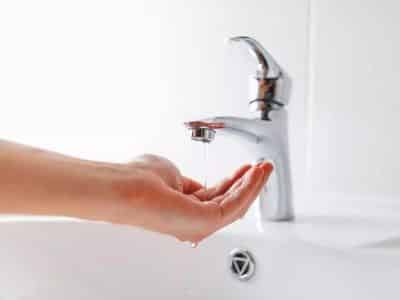
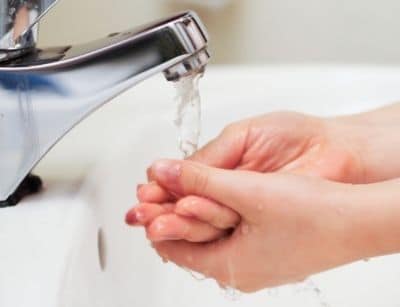
Hand receiving water from a modern faucet, illustrating the importance of consistent water pressure for household plumbing efficiency.The home thrives on decent water pressure. This is what allows the dishwasher to function properly. It also makes showering a pleasurable experience. Poor water pressure prevents appliances from working properly and lowers residents’ quality of life. 

A water leak can cause low water pressure because there’s water leaving the system. Pressure can’t build up in the system because water isn’t flowing properly. A professional can address the leak (and restore water pressure to the home) by: 

  • Using soundwaves to locate the leak’s source 
  • Turning on different water fixtures and examining the water’s pressure 
  • Using a drain snake with a camera 

How the plumber fixes the leak is a different story. If the pipe has only suffered minimal damage, they may consider fixing the leak with an epoxy. They may also replace the section of pipe, patch the leak, or recommend other measures. It’s important to leave these measures to a professional. DIY measures can only make the problem worse. 

Having Higher Water Bills

Dollar bills being washed down a sink drain, symbolizing wasted money due to potential water leaks and higher water bills.Martin County charges homeowners for water based on their usage. It notes that for the first 10,000 gallons, one can expect to pay $2.38 per 1,000 gallons. The rates only increase from there. 

Homeowners should have a basic understanding of how much Martin County charges for water. They should also know how much they pay for water each month. If they notice an unexplained increase in their water bill, this could point to a water leak. Martin County does not differentiate between water homeowners intentionally use and water that escapes the plumbing system through leaks. 

In the face of high water bills, one should consult a professional. They can assess the plumbing system and render any necessary repairs. 

About Allore’s Plumbing Services LLC 

Allore’s Plumbing Services LLC opened its doors in 1986 with one goal: to serve the people of Stuart, Florida. Founded by a navy veteran, they offer proficient repairs that can only come from 30-plus years of experience. For help with water leaks, interested parties can schedule appointments online. They can also call to speak with a representative.

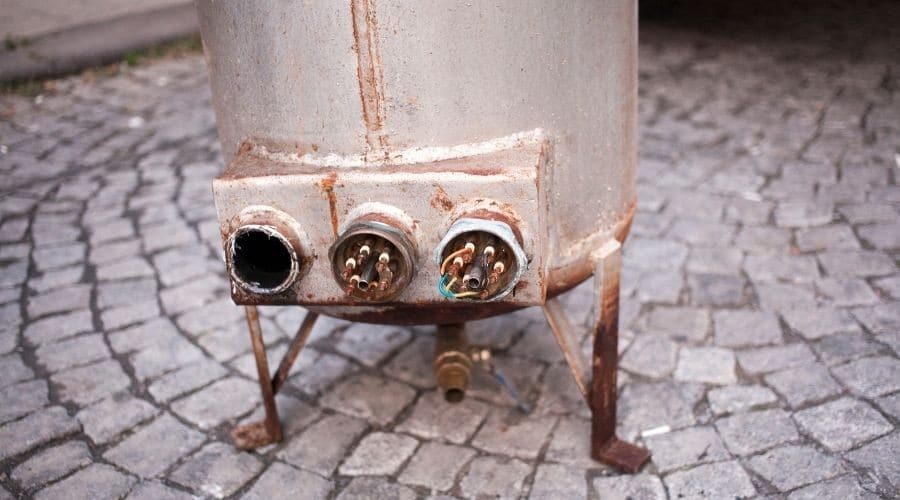
Rusty metal water heater with electrical connectors on textured cobblestone ground, representing plumbing maintenance issues.

Signs It’s Time To Dump That Old Water Heater

When Is the Right Time for a Water Heater Replacement?

Breaking up is hard to do – it’s one of those age-old facts. And it doesn’t just apply to romantic relationships that aren’t going anywhere or fling that have lost their spark. It can also be true for the often complicated relationship between a homeowner and their water heater.

Not only can it be painful in a financial sense to break it off with that old water heater, but it can also be difficult to know when the time has come to say goodbye. This article will lay out three of the biggest red flags for homeowners to watch out for when it comes to their water heaters.

The Water Heater Is Getting Old

The first way to tell it might be time to call it quits with the water heater is if the unit is nearing the end of its life expectancy. This number varies depending on the unit type, the quality of installation, and how well it has been maintained, but there are a few general guidelines.

A traditional gas water heater has an expected lifespan of around 8-12 years. The same goes for traditional electric water heaters, though some have been known to last a year or two longer. On the other hand, tankless water heaters tend to last closer to 20 years, whether gas or electric. Of course, regular water heater service will help extend this, but even that has its limits.

The date of installation is typically marked on the manufacturer label on the unit itself. If it was more than 10 years ago (on a traditional unit) or close to 20 years ago (on a tankless unit), it’s a good bet that the unit won’t last much longer, especially if it’s been acting up lately.

The Water Heater Has Sprung a LeakLeaking traditional gas water heater with water pooling on the floor, indicating potential maintenance issues and the need for replacement.

If the water heater is leaking, it may be something as simple as a loose pipe fitting or a faulty T&P (temperature and pressure) relief valve. But it could also be something much more serious, such as a crack or pinhole leak in the tank itself. A leak could indicate mineral deposits or corroded pipes in a tankless unit. Still, leaks are much less common on tankless units, especially if they’re nowhere near the end of their life expectancy.

On a traditional unit, a leaking water tank is usually the result of corrosion eating away at the tank wall or sediment collecting in the bottom of the tank and causing cracks. In either case, once the tank itself is compromised and springs a leak, it will need to be replaced, and it will simply be more cost-effective to replace the entire unit.

Plumber inspecting a water heater, checking pipe fittings and valves for maintenance issues related to leaks and inefficiencies.


The Water Heater Just Won’t Work Properly

Another sign it might be time to ditch the current water heater is if it continually breaks down or fails to work properly. A unit that requires frequent repairs will eventually cost more than investing in a whole new water heater. Similarly, even if the unit has been working fine previously, an issue may arise and cause costs to pile up. 

For instance, if an electric heating element burns out or breaks, another element may work harder to compensate, degrading efficiency and driving up energy costs. And if the unit is older, it may make more sense to upgrade than to shell out for a new heating element.

In some cases, the unit or tank may not be the appropriate size for the home, either because the original water heater installer miscalculated or the household needs have changed since the unit was first installed. In this case, upgrading to a properly sized unit can drastically improve efficiency.

About Allore’s Plumbing Services LLC

Allore’s has been the go-to plumbing company in their community for over 30 years. As an award-winning and consistently 5-star rated local business, they guarantee 100% satisfaction on every single job. Their friendly, trustworthy experts are available 24/7, so don’t wait to call Allore’s for water heater installation in Stuart, FL.

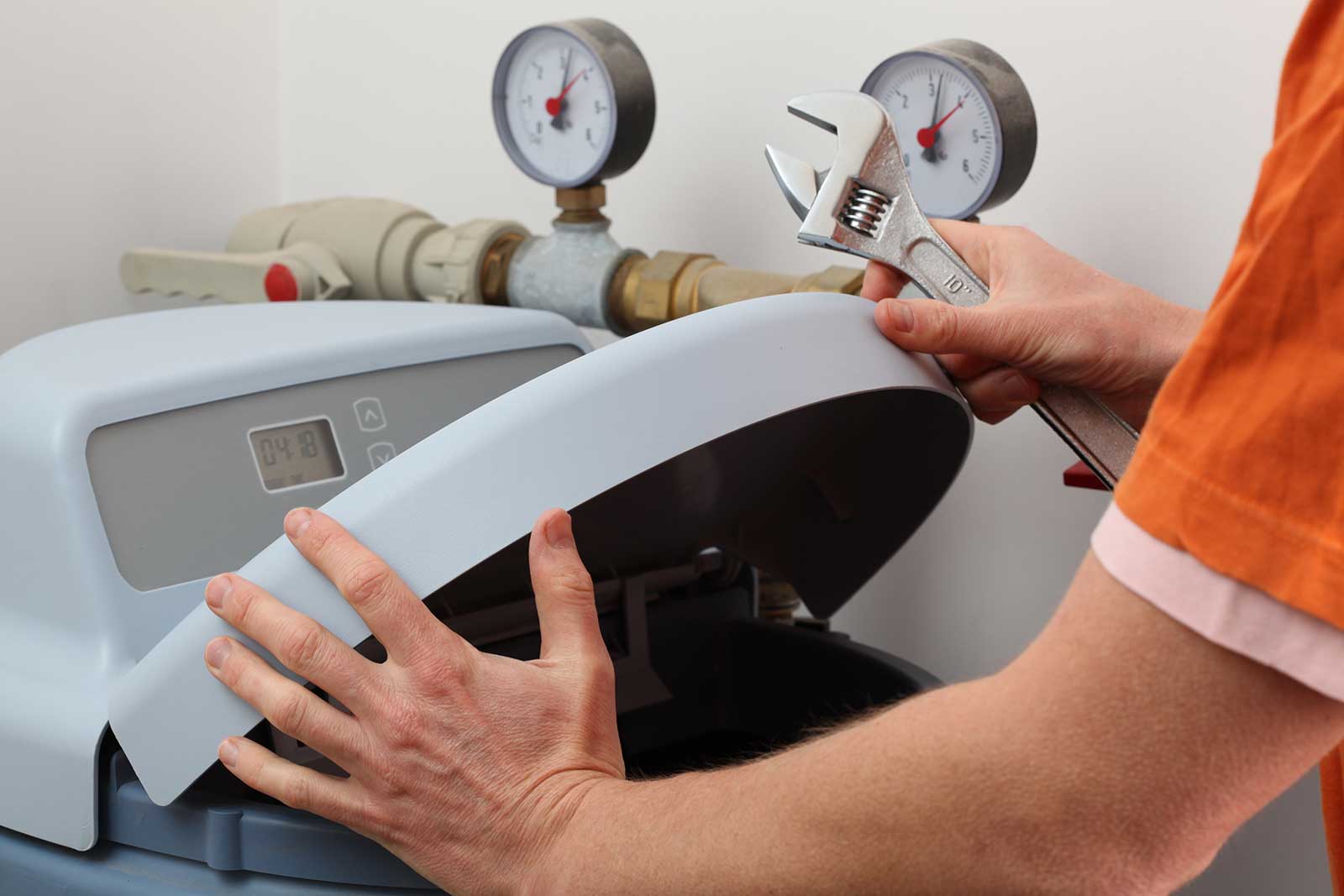
Person using an adjustable wrench on a machine with pressure gauges in an industrial setting for plumbing repair services.

3 Signs You May Need To Install a Water Softener

Do You Have Hard Water In Your Home?

For many homeowners, the distinction between hard and soft water is not a familiar concept. After all, what exactly does it mean when water is “hard?” Hard water is simply water that contains a high concentration of dissolved minerals. While this doesn’t make much difference in terms of the water’s safety, it can significantly impact the plumbing system itself – not to mention the comfort of everyone in the home. 

One solution is to install a water softener to remove these minerals from the water supply, but many homeowners wonder if it’s really necessary. So this article will lay out the three most common signs that a home has hard water, how it can affect the home and its plumbing, and how to tell when it’s time to install a water softener.

Visual Cues

Thanks to its high mineral content, hard water tends to leave behind a residue when it dries out – the water evaporates, but the minerals stay put. It’s common for dishes washed in hard water to be covered in cloudy white spots or become slightly opaque over time. 

Over time, small mineral deposits like these may accumulate on faucets and showerheads, forming a hard white or greenish crust around the spigot or nozzle. Unusually high amounts of soap scum buildup in sink basins or on shower walls may also indicate hard water, as the dissolved minerals bind with the soap and cause it to hang around on surfaces after the water evaporates.

That Hard Water FeelingHands washing under a faucet with flowing water, illustrating the effects of hard water on skin and plumbing surfaces.

Hard water can also be detected by the way it leaves skin, hair, and laundry feeling. Many people with hard water in their homes find that their skin feels very clean after bathing but then becomes dry, itchy, or irritated after they’ve dried off. This is because hard water leaves behind a mineral residue on the skin, just as it does on other surfaces.

This residue can clog pores and prevent the body’s natural oils from moisturizing the skin. It may have an even more pronounced effect on hair, leaving it flat and dry and cause the scalp to become flaky. These effects aren’t limited to the body, however – the residue of dissolved minerals can leave laundry feeling rough, stiff, or scratchy.

Problems with the PipesPerson repairing leaking white plumbing pipes under a sink, using a yellow cloth to wipe water, illustrating plumbing maintenance related to hard water issues.

Another clue that the home’s water is hard may come in the form of plumbing issues. As hard water travels through the home’s pipes, it will leave its trademark mineral scale deposits on the pipe interiors as well as the internal components of fixtures and appliances. Eventually, this scale buildup will interfere with the normal function of the plumbing system.

Mineral scale can obstruct water supply pipes and the larger drainage pipes, resulting in low water pressure or drain clogs, respectively. It can also lead to corrosion, excessive vibration, and overpressurization of copper supply lines, all of which can cause leaks or ruptures. Appliances like water heaters, dishwashers, and washing machines can wear out faster, or malfunction as scale interferes with their internal components.

With all this in mind, it’s easy to see why removing these troublesome minerals with a water softener might be a good idea, not just for comfort but also for the health of the home’s plumbing and appliances. If in doubt, homeowners can contact their preferred plumber to determine whether a water softener is right for them.

About Allore’s Plumbing Services LLC

Allore’s Plumbing Services LLC is an award-winning, veteran-owned local business with over 35 years of experience serving its community. They offer up-front, competitive pricing and 24/7 emergency service. Call Allore’s today for water softener services in Stuart, FL!